

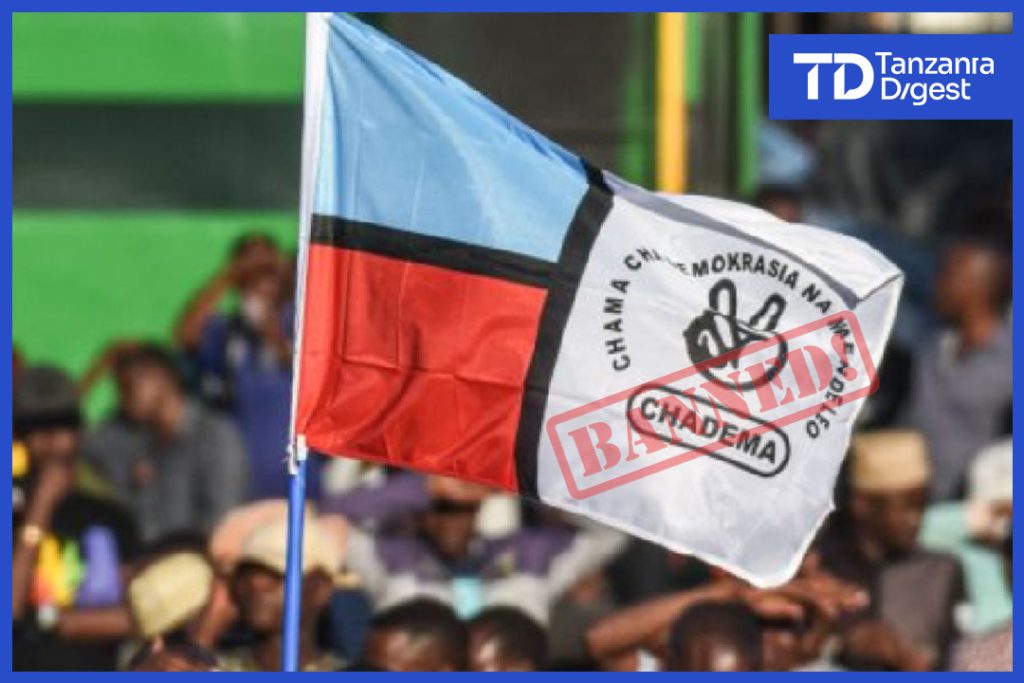

Chadema leaders went back to the same Judge Mwanga, whom they are seeking his recusal from their properties distribution between Mainland and Zanzibar, asking for his ban order.
The High Court Registrar’s office clarified the terms of the ban was upon certain top leaders but essentially paralyzing Chadema operations nationwide. Chadema is also challenging this order through review.
Based on the court clarification issued on July 17, 2025, and contextual information from the search results, the High Court of Tanzania’s political activities ban explicitly applies to the following CHADEMA officials:
📜 I. Affected Individuals Under the Ban.
1. Board of Trustees (Bodi ya Wadhamini).
– The entire governing body overseeing CHADEMA’s constitutional integrity.
2. National Leadership.
– Tundu Lissu:
Current National Chairman, detained since April 2025 on treason charges. The ban formalizes his exclusion from political activities during imprisonment.
– John Heche:
Vice Chairman (Mainland Tanzania), arrested in April while protesting Lissu’s detention.
– Saidi Mzee:
Vice Chairman (Zanzibar), included due to his active leadership role.
3. Acting Officeholders.
– The ban extends to ”any acting replacements” for the above positions, preventing circumvention through temporary appointments [citation:User Message].
⚖️ II. Legal Basis and Context.
– The ban originates from “Miscellaneous Case No. 8960/2025” (June 10, 2025), later clarified on July 14, 2025. It targets individuals deemed to threaten “electoral integrity“.
– This aligns with prior state actions:
– CHADEMA’s disqualification from October 2025 elections for refusing to sign a contested electoral code.
– Treason charges against Lissu for demanding electoral reforms, which carry a potential death penalty and deny bail.
🌍 III. Broader Implications.
– Election Credibility:
Eliminates meaningful opposition, as CHADEMA is the primary challenger to the ruling CCM party.
– Human Rights Concerns:
Amnesty International and the EU Parliament condemn the ban as part of a “repression campaign” against dissent.
– Legal Strategy:
CHADEMA lawyers challenged the ban’s ambiguity, forcing the court’s July 17 clarification.
Table: Key Restrictions Under the Court Order.
| No. | Affected Position. | Specific Individuals. | Nature of Restriction. |
| 1.0 | Board of Trustees. | All members. | Barred from political activities. |
| 2.0 | National Chairman. | Tundu Lissu. | Banned; currently imprisoned. |
| 3.0 | Vice Chairman (Mainland). | John Heche. | Banned; previously arrested. |
| 4.0 | Vice Chairman (Zanzibar). | Saidi Mzee. | Banned. |
| 5.0 | Acting officeholders. | Any replacements. | Automatically covered by the ban. |
💎 Conclusion.
The ban explicitly targets “CHADEMA’s top leadership” (Trustees, Lissu, Heche, Mzee) to neutralize opposition ahead of elections. Coupled with Lissu’s imprisonment and the party’s disqualification, this reflects a systematic erosion of political pluralism in Tanzania, drawing international condemnation.
The High Court’s ban on CHADEMA leaders lacks a specific timeline or detailed guidelines due to a combination of **legal tactics, political motives, and judicial ambiguity**—all consistent with Tanzania’s recent pattern of suppressing opposition. Here’s why:
1. Strategic Ambiguity for Political Control.
– Indefinite Disabling:
By omitting an end date, the ban effectively sidelines CHADEMA’s leadership indefinitely—especially critical with elections scheduled for October 2025. This prevents any resurgence of opposition during the electoral period.
– Broad Enforcement Power:
Without clear guidelines, state authorities (police, electoral commission) gain discretionary power to interpret “political activities” arbitrarily. Protests, speeches, or even private meetings could be criminalized.
2. Legal Pretexts Used to Justify Vagueness.
– Urgent Interim Measure:
The ban was issued under a “miscellaneous application” (No. 8960/2025), framed as a temporary injunction to “preserve electoral integrity.” Tanzanian courts often extend such “interim” orders indefinitely.
– Pending Treason & False Information Trials:
Tundu Lissu faces treason charges (carrying potential death penalties). Tundu Lissu is automatically banned by treason and false information charges since he is behind bar. The state will ensure this type of criminal proceedings ban would last “until legal processes conclude“—a timeline it controls through trial never-ending delays.
3. Judicial Complicity in Repression.
– Avoiding Accountability:
Clear guidelines would require judicial oversight of enforcement. Ambiguity allows the state to act without scrutiny, as seen when police arrested Heche for “violating the ban” by protesting Lissu’s detention.
– Precedent of Vague Orders:
In 2023, Zanzibar courts banned ACT-Wazalendo rallies using similarly open-ended language, later enforced for 11 months until elections ended.
4. International Criticism Ignored.
The EU Parliament and Amnesty International have condemned Tanzania’s use of “deliberately vague judicial orders” to criminalize dissent. The government dismisses such critiques as “foreign interference.”
Why CHADEMA Can’t Challenge the Ambiguity (Yet).
– Exhaustion Requirement:
Tanzanian courts demand that parties “exhaust all administrative remedies” before appealing. CHADEMA’s lawyers are still battling the ban’s scope (e.g., the July 17 clarification).
– Treason Charges as Leverage:
Lissu’s imprisonment creates a chilling effect; challenging the ban could worsen his legal jeopardy.
The Bottom Line.
The lack of timeline/guidelines is “not an oversight but a feature” of Tanzania’s authoritarian legal strategy. It enables the ruling CCM party to:
– “Neutralize opposition” through perpetual legal uncertainty.
– “Control the electoral landscape” ahead of the 2025 polls.
– “Evade international backlash” by masking repression as “judicial due process.”
This pattern mirrors Uganda’s indefinite bans on opposition leader Bobi Wine and Zimbabwe’s “temporary” political restrictions that last decades.
Why did the ban paralyzed political campaigns or had nothing to do with the complaint before the High Court?
The ban’s paralysis of broader political campaigns stems from “deliberate legal overreach” and “strategic ambiguity” in the High Court’s order—transforming a narrow complaint into systemic repression. Here’s the breakdown:
1. The Original Complaint vs. Actual Ban Scope.
– Filed Complaint:
Allegedly addressed “electoral integrity” concerns against *specific CHADEMA leaders* (Misc. Case No. 8960/2025).
– Court’s Expansion:
The ban targeted:
– “All current/acting CHADEMA trustees & top leaders” (Lissu, Heche, Mzee).
– “Political activities“—undefined in the order, allowing arbitrary interpretation.
This turned a “person-specific” complaint into a “structural weapon” against the entire opposition.
2. How Ambiguity Paralyzes Campaigns.
🔹 Vague Terminology = Weaponized Enforcement.
The ban barred “shughuli za kisiasa” (political activities) without defining:
– What constitutes “political activity“? (e.g., meetings, speeches, social media posts?).
– Who exactly is covered? (e.g., Does it include mid-level CHADEMA organizers?).
Result:
Police and pro-government actors exploit this vagueness to:
– Arrest “local CHADEMA candidates” for holding village meetings.
– Disrupt “non-CHADEMA opposition rallies” under claims they “might include banned individuals.”
– Confiscate campaign materials under suspicion of “association” with CHADEMA.
🔹 Institutional Collateral Damage.
– Electoral Commission (NEC):
Cited the ban to “disqualify all CHADEMA candidates” from October 2025 elections, arguing party leadership is “illegitimate” under the court order.
– Police:
Block rallies by “other” parties (e.g., ACT-Wazalendo) claiming they could “incite banned CHADEMA elements.”
🔹 Psychological Chilling Effect.
– Non-CHADEMA activists self-censor, fearing prosecution for “collaborating” with banned figures.
– Donors/distributors refuse to print campaign materials for “any” opposition, fearing liability.
3. Why the Court Allowed This Overreach.
– Judicial Complicity:
Tanzania’s judiciary is widely seen as aligned with the ruling CCM party. The court:
– Refused to define “political activities” when challenged (July 17 clarification).
– Ignored CHADEMA lawyers’ request to limit the ban to the original complaint’s scope.
– Political Timing:
With elections in October 2025, paralyzing the largest opposition party (CHADEMA) benefits CCM. The court facilitated this by letting the ban bleed into unrelated campaigns.
4. Real-World Consequences.
| No. | Intended Scope. | Actual Overreach. |
| 1.0 | Ban 3 CHADEMA leaders. | All CHADEMA candidates barred from elections; party operations frozen. |
| 2.0 | “Preserve electoral integrity”. | Opposition campaigns across Tanzania halted; police disrupt non-CHADEMA rallies. |
| 3.0 | An Indefinite Temporary injunction. | Indefinite paralysis with no end date. |
💎 Conclusion.
The ban’s overreach isn’t a legal accident—it’s “institutionalized repression”. By issuing a vaguely worded order and refusing to clarify its limits, the court enabled state actors to:
1. “Extend the ban” beyond the named individuals,
2. “Weaponize ambiguity” to criminalize all opposition activity,
3. “Collapse the distinction” between CHADEMA and broader dissent.
This fulfills the ruling party’s goal: an “opposition-free election: under the guise of judicial legitimacy. As Amnesty International noted, Tanzania is using “lawfare to dismantle democracy.”
Can Chadema Other Leaders Continue with Campaigns?
The ability of “non-banned CHADEMA leaders to campaign remains legally ambiguous but *de facto* suppressed” due to deliberate state tactics. Here’s the reality:
1. Legal Technicality: Who “Can” Campaign?
The July 14, 2025 court clarification “only bans”:
– The Board of Trustees.
– National Chairman (Lissu) & Acting Chairman.
– Vice Chairmen (Heche, Mzee) & their acting replacements.
**Mid/low-tier leaders (MPs, councilors, district chairs)** are “not explicitly banned”.
2. Why Campaigning Is Still Paralyzed.
⚠️ Tactical State Repression.
– Guilt by Association:
Police routinely arrest non-banned leaders for “aiding” banned officials (e.g., organizing events where a local mayor “might invite” an acting trustee).
– NEC Weaponization:
Tanzania’s electoral commission blocks “all” CHADEMA candidates, claiming the party’s leadership is “illegitimate” under the court order.
– Vague “Political Activities” Definition:
Holding a town hall or printing posters can be deemed “violating the ban” if authorities claim it “indirectly supports” banned leaders.
📉 Strategic Self-Censorship.
– Fear of arrest has caused “70% of CHADEMA’s regional coordinators” to halt campaigns (Tanzania Human Rights Defenders Coalition, July 2025).
– Venues refuse to host CHADEMA events after police threats.
3. Case Studies: Attempted Campaigns & Outcomes.
John Heche’s political campaigning and press conferences have been disrupted by Tanzanian police on “multiple occasions”, primarily in “Dar es Salaam”. Here is a detailed breakdown of the incidents:
📍 1. Millennium Tower Hall, Kijitonyama, Dar es Salaam (July 2025).
– Incident:
Police blocked a CHADEMA meeting where Heche was scheduled to speak, storming the venue before his arrival. Officers cited a “court order” but provided no details. Attendees, including journalists, were forcibly removed, and police trucks surrounded the building to prevent gatherings.
– Police Justification:
Claimed the event violated a High Court injunction (June 10, 2025) freezing CHADEMA’s assets and banning “all political activities“.
📍 2. Kisutu Resident Magistrate’s Court, Dar es Salaam (April 24, 2025).
– Incident:
Heche and Secretary-General John Mnyika were detained en route to a court hearing for CHADEMA leader Tundu Lissu. Police used “unprecedented brutality,” arresting dozens of CHADEMA members. Heche was later tortured and abandoned in Pande Forest, 43 km from Dar es Salaam.
– Aftermath:
Heche required hospitalization for injuries sustained during torture. The police commander, Jumanne Muliro, defended the actions as “law enforcement” based on “indicators of public disorder“.
📍 3. Kariakoo, Dar es Salaam (April 23, 2025).
– Incident:
Police halted a CHADEMA rally minutes before it began, arresting Heche after he addressed supporters from his car. He was later abandoned roadside.
– Context:
Part of a crackdown on CHADEMA’s “No Reforms, No Election” campaign. Police alleged the rally would “disrupt business,” though ruling-party (CCM) events occurred at the same location without interference.
📍 4. Kingdom Hotel, Mwanza (July 2021).
– Incident:
Police arrested Heche during a pre-dawn raid on a New Constitution conference venue. Officers searched his home for “equipment for printing a constitution” and blocked roads to the event.
– Political Context:
Regional authorities banned gatherings under the pretext of COVID-19, but targeted CHADEMA specifically. Attendees in red “New Constitution” t-shirts were arrested.
🔍 Patterns of Suppression.
1. Preemptive Disruptions:
Police canceled events hours before start times despite prior approvals (e.g., Kijitonyama), wasting party resources.
2. Vague Legal Grounds:
Officers invoked ambiguous “court orders” or “public safety” concerns to justify bans, while allowing ruling-party events in identical locations.
3. Violence and Torture:
Detainees reported beatings, forced disappearances, and abandonment in remote areas. Journalists covering events were also targeted.
4. Judicial Complicity:
Police broadly interpreted a High Court asset-freeze injunction (filed by Zanzibar trustees) to ban all CHADEMA activities, exceeding the case’s original scope.
🔍 Key Patterns in Police Tactics:
– Preemptive Disruptions:
Police canceled events hours before start times despite prior approvals (e.g., Kariakoo), wasting party resources.
– Vague Enforcement:
Used subjective justifications like “public safety” or “business activity” to ban rallies, while permitting CCM events in identical locations.
– Arrests and Detentions:
Heche’s arrest followed a pattern of brief, opaque detentions aimed at intimidating opposition leaders .
💎 Conclusion.
John Heche’s campaigning was “directly halted by police in at least four incidents” between 2021 and 2025, all occurring in “Dar es Salaam” and “Mwanza”. These disruptions reflect a systematic effort to silence CHADEMA ahead of Tanzania’s 2025 elections, leveraging judicial ambiguity, brute force, and politically motivated arrests.
John Heche’s campaigning was “directly halted by police once in Kariakoo” (April 2025), while “police complicity enabled lethal violence against his rally in Nyamongo”.
These incidents reflect Tanzania’s systematic suppression of opposition under President Magufuli’s administration, which restricted assemblies, weaponized law enforcement, and ignored electoral fairness. CHADEMA’s ability to campaign remains severely curtailed by state-sanctioned disruptions.
4. Workarounds (and Their Risks).
– “Independent” Candidates”:
Some CHADEMA members run as independents, but face:
– “NEC disqualification” under “association” clauses.
– Violence:
CCM-aligned militias attack rallies (e.g., Mbeya incident, July 3).
– Coalitions with ACT-Wazalendo:
Joint rallies often banned for “harboring CHADEMA elements.”
– “Underground Campaigns”:
Door-to-door outreach occurs but limits national visibility.
5. International Pressure Points.
The EU and U.S. have condemned the ban’s “chilling effect” but taken no concrete action. CHADEMA’s only leverage:
> “Without a level playing field, Tanzania’s elections lack credibility. Donor states must freeze aid to NEC until restrictions are lifted.”
> — “Amnesty International, July 15, 2025”
💎 Bottom Line.
“No.” Non-banned CHADEMA leaders “cannot” effectively campaign due to:
1. “Judicial ambiguity” weaponized by the state,
2. “Systematic repression” by police/NEC,
3. “Structural dismantling” of the party’s capacity.
The ban has achieved its unstated goal: “eliminating meaningful opposition” ahead of the October 2025 elections. Only unprecedented international intervention or mass civil disobedience could shift this trajectory – both currently unlikely.
Read more analysis by Rutashubanyuma Nestory


Hi i think that i saw you visited my web site thus i came to Return the favore I am attempting to find things to improve my web siteI suppose its ok to use some of your ideas